
My 2026 Goal: Learning

“For the things we have to learn before we can do them, we learn by doing them.”
— Aristotle, The Nicomachean Ethics
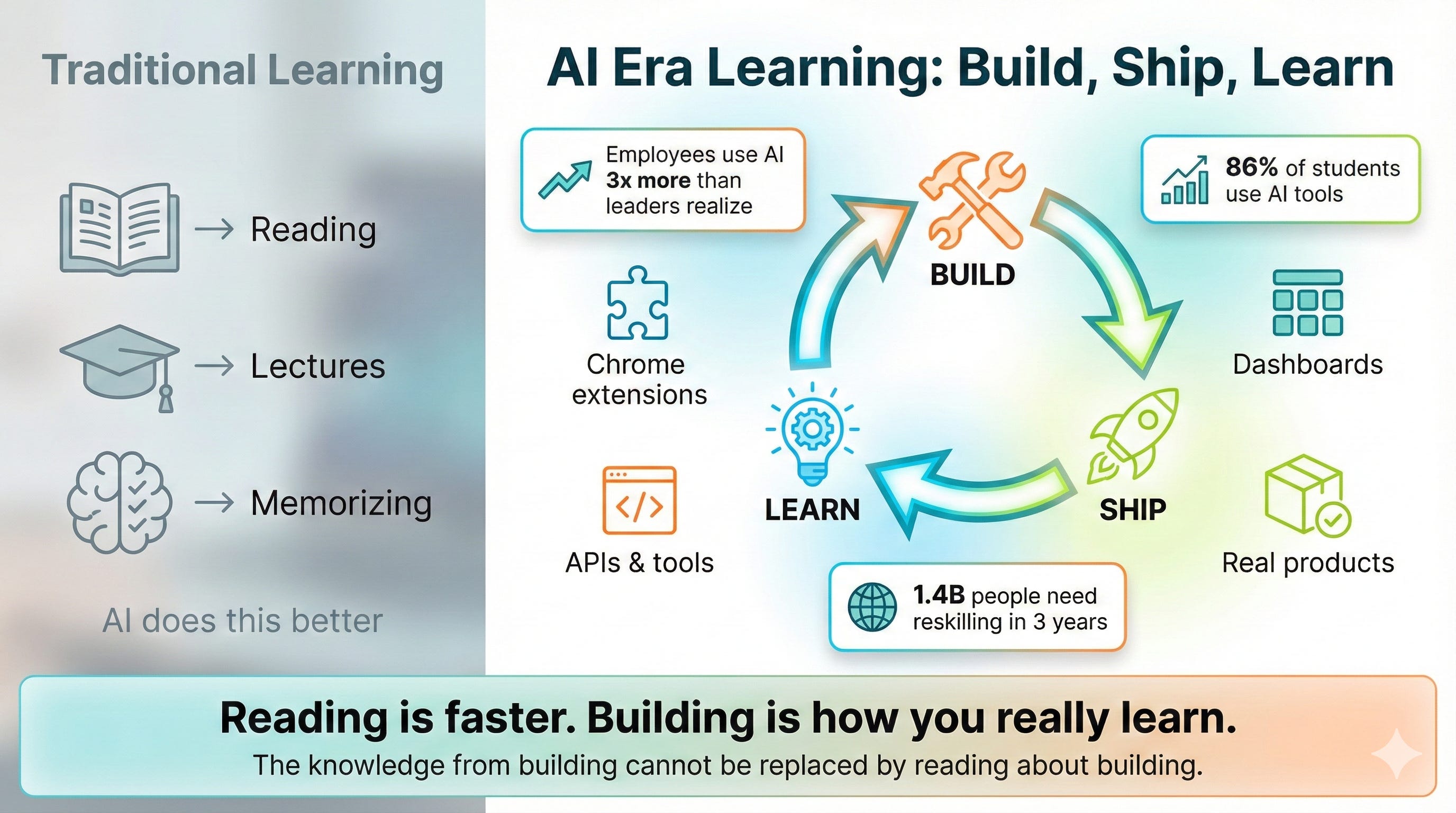
Three months ago, I left Google after more than 10 years. Since then, I have built a Chrome AI extension in two days, created a monitoring dashboard in a week, developed an MCP server for crypto trading, and explored everything from visual tokenizers to CLI workflows. People sometimes ask me whether I have a clear goal.
I do. My goal is learning.
And learning will continue to be my goal for the whole of 2026.
The Career Break as School
I am treating this career break like going back to school, but with a critical difference. I am not attending lectures or memorizing facts. I am building things.
In the AI era, reading and memorizing information no longer works the way it used to. AI can read faster, recall more accurately, and synthesize information more efficiently than any human. Research shows that 86% of students already use AI tools in their learning, with the technology fundamentally reshaping how knowledge is acquired and applied.
The new way to learn is to actively use AI to build things. This is not theoretical. When I built NanoCoffee, my first AI Chrome extension, in two days, I learned Chrome’s built-in AI capabilities in a way that reading documentation never could. Reading is faster. You do not need to build anything. But reading does not let you really learn it. When I created PeekDeck, a dashboard generator, in a week through vibe coding, I understood the practical strengths and limitations of AI-assisted development in ways that no tutorial could teach.
Building with AI teaches you what AI actually can and cannot do. Without this first-hand experience, it is easy to fall into one of two extremes: either freaking out over messages that AI will replace everything, or remaining completely blind to how AI is changing the world. Both perspectives miss the reality. The only way to understand what is really happening is to use AI to build websites, apps, images, and videos yourself.
Why Open-Ended Exploration Works
Every day, I explore different areas without a predetermined endpoint. Some people wonder if this is too unfocused. I think the opposite. In a world where 1.4 billion people will need to reskill within three years due to AI’s impact, and where AI tools enable work that once took weeks to now be completed in hours or days, narrow specialization is the riskier strategy.
After 10 years at Google focusing on relatively narrow technical areas, I have a lot to catch up on. The tech landscape has shifted. AI is not just a new tool. It represents a fundamental change in how software is built, how products are shipped, and how value is created.
I learn and build whatever motivates me. One week it is Chrome extensions. The next week it is monitoring dashboards. Then crypto trading protocols. Then CLI workflows. This is not scattered attention. This is deliberate breadth. Each project teaches different aspects of how AI changes development, deployment, and product design.
The projects I ship are real and functional. NanoCoffee is published on the Chrome Web Store. PeekDeck is deployed and running. The MCP server works with live trading. These are not mock demos or academic exercises.
Do they have many users? No. I have no distribution channel and I do not do marketing. That is intentional. Growing users is not my goal, at least for now. The primary value is not the user count. The value is what I learn by building and shipping real products that solve real problems.
The Economics of Self-Directed Learning
Yes, I lost the very good compensation from Google. But I also avoided tuition costs through self-study. Many developers are entirely self-taught, and in the AI era, self-directed learning is probably more effective than traditional school.
Traditional education moves slowly. Curriculums are designed months or years in advance. By the time a course is taught, the technology may have evolved. Self-directed learning with AI lets you stay current. When a new capability launches, you can start experimenting immediately. When a new pattern emerges, you can build with it the same day.
The tradeoff is financial. No salary means no income. But it also means no constraints on what to learn or how to spend time. For someone interested in understanding how AI is reshaping software development, this flexibility has significant value.
Looking Ahead to 2026
I do not know exactly what I will build in 2026. That is intentional. The AI landscape is changing too fast for rigid plans. Employees are using AI three times more than leaders realize, and the pace of change is accelerating.
What I do know is that I will continue learning by building. I will explore areas that motivate me. I will ship real products. I will write about what I discover. And I will stay flexible enough to adapt as the landscape shifts.
For anyone considering a similar path, the key insight is this: in an era where AI can read and memorize better than humans, the most valuable learning comes from doing. Build things. Ship them. Learn from what works and what does not. The knowledge you gain from building cannot be replaced by reading about building.
2026 will be my year of learning. Not as a passive student, but as an active builder.