
My Most Important User
A story of AI, fatherhood, and building technology that creates connection, not just engagement.

The most powerful applications of AI aren’t always the ones that scale to billions. Sometimes, they scale to just one.
There’s a unique silence that follows a story that doesn’t land. It’s not an angry or disappointed silence. It’s a quiet drifting. The subtle, unmistakable sign that the connection has been lost. I could see it in my daughter’s eyes. Some stories would pull her in, her world shrinking to the size of the narrative. Others, often classics I thought were a sure thing, would just wash over her. The magic was hit-or-miss.
As a parent, it felt like a failure. Professionally, it felt like a familiar problem: a breakdown in user engagement.
The classic audiobooks and stories we tried were generic products, designed for a mass market. But my audience was one. And for this user, the product wasn’t working. The issue wasn’t a lack of quality content, but the inherent distance between her specific, rapidly evolving world and the static world of the stories.
So I decided to approach this not just as a father, but as a builder. Instead of searching for the perfect story, I decided to assemble a process to create it.
To be clear, I didn’t build a new product from scratch. This wasn’t about writing complex code, but about creative orchestration—finding and combining the right set of existing tools in a novel way to achieve a specific, personal goal.
Crafting Connection: A New Storytelling Engine
My core principle was simple: the stories had to be deeply personal and beneficial. They needed to do more than entertain; they needed to serve a purpose, like helping her process a new experience or encouraging a virtue like confidence.
This wasn’t about building an entertainment product. This was about building a development tool. My process looked like this:
The Blueprint: Advanced Prompt Engineering: I learned that effective prompt engineering was key. Instead of a simple “write a story” command, the trick was to have the AI act as a ‘story director.’ I created a multi-step process where I first provided the key parameters—a persistent story world, a cast of recurring characters, and her current life context. The AI would then generate a narrative plan before writing the actual story.
The Objective: Each story had a clear goal. The objective wasn’t just “tell a fun story,” but something more specific, like “write a story where the main character overcomes a moment of shyness to ask for help.”
From Text to Audio: The AI would generate a draft, which I would then edit. Then came the challenge of finding the right text-to-speech (TTS) tool. Many services exist, but it took significant trial and error to find one with the right balance of natural-sounding prosody and ease of use.
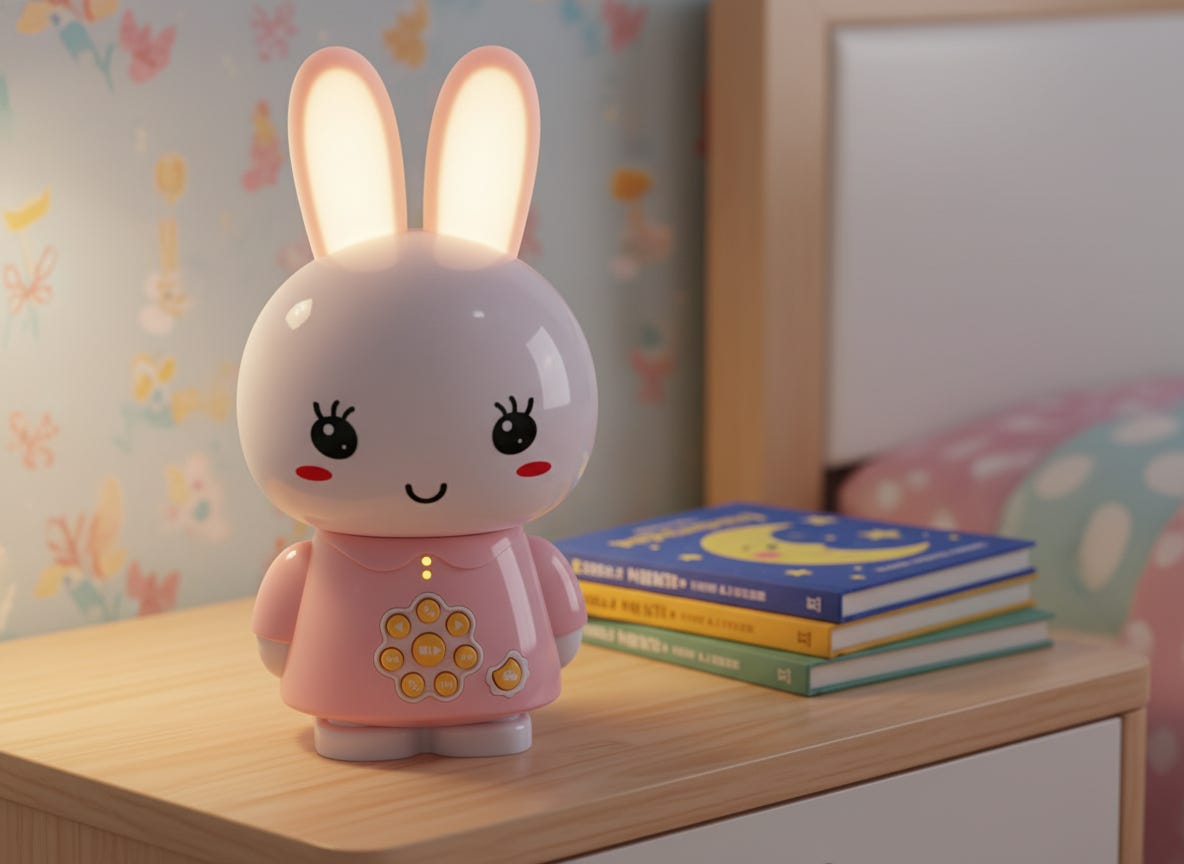
The results were immediately promising. Engagement shot up. On a practical level, the system was working. The stories were a hit.
But the builder in me knew this was just the first iteration. The real breakthrough—the one that shifted this from a fun project to a profound experiment—came when I decided to radically redesign the user interface: the very medium of the story itself.
The Immersion Engine: When the Hero is You
The biggest leap in any technology is usually the one that erases the final layer of abstraction between the user and the experience. In a story, what is the final abstraction layer?
The narrator.
I rewrote the stories from a first-person perspective. Instead of “She was brave,” it became “I took a deep breath and felt brave.” But the true catalyst was the audio. I used a zero-shot AI voice-cloning tool, which only required less than a minute of my daughter’s speech as input to generate the narration.
The effect was electric.
When she first heard her own voice narrating her own adventure, she fell silent. Not the drifting silence of disconnection, but the stunned, absolute silence of immersion.

That initial silence soon gave way to proactive requests. After she earned her purple belt in kung fu, she immediately asked me to create a new story where she had her new belt. The stories had become a part of her life.
She was no longer a passive listener. She was the hero, the narrator, and the audience, all at once.
She wasn’t just hearing about a character who struggled with a difficult kung fu move; she was hearing herself describe the internal monologue of frustration and focus. In her new story, she heard her own voice say, “I looked at the purple belt around my waist. The dragon spirit of the purple belt flowed into me. I was ready for the next challenge.”

We had moved beyond simple personalization into the realm of identity synthesis. The stories weren’t just for her anymore; they were her.
And this is where the builder had to take a step back and ask not just “does it work?” but “what does it mean?”
The Creator’s X-Ray: Unpacking the Implications
Creating an experience this powerful for your own child forces you to confront its potential impact with a level of seriousness you might not afford a standard tech product. I had to look past the functionality and analyze the deeper mechanics.
The Power of Self-Narration
The most significant positive effect is the reinforcement of self-efficacy. When a child hears her own voice articulating the process of overcoming a challenge, it’s not just an abstract lesson. It’s a rehearsal for real life. Hearing one’s own voice narrate personal challenges can create a powerful mental blueprint for resilience. The stories don’t always end in a clear “success,” but they always feature her working through the problem—which is a far more valuable lesson.
The Risk of the Perfect Echo Chamber
If you create a media universe perfectly tailored to one person, what happens when they encounter content that isn’t about them? This is a valid concern. My approach has been to treat these stories as a nutritional supplement, not a replacement for a balanced diet. We still read countless classic books and watch shows with diverse characters. The goal of the AI stories is to build a strong internal foundation so she’s better equipped to explore the wider world, not retreat from it.
Navigating the Uncanny Valley
The voice cloning isn’t perfect. There are slight, uncanny artifacts in the audio. Initially, I worried this would be distracting, but it seems to have had the opposite effect. I realized that because the core stories were entirely fictional—with invented characters and situations—the use of her real name, age, and recent experiences acted as an anchor, not a source of confusion. This provides a clear boundary, a safe space where the “story self” can explore challenges without blurring the line with lived reality.
Building for One
This entire project became a microcosm of a philosophy I’ve come to embrace. We are all builders. In our careers, we are often compensated and promoted for building systems that scale—that serve billions of users, that optimize for engagement across entire populations.
But the most profound applications of our skills often don’t scale at all.
We spend our lives honing our craft, becoming experts in designing complex, efficient, and powerful systems. We learn to think in terms of leverage, impact, and total addressable market. It’s the default language of our industry, but it doesn’t have to be our only one.
Yet, this project was a lesson in building for an audience of one. Its metrics weren’t daily active users, but the depth of connection with a single person. Its goal wasn’t to capture attention, but to build a soul.
This, for me, is the practice of a life driven by curiosity. It’s the conscious decision to take your sharpest, most valuable professional tools and apply them to your softest, most personal problems. It’s the recognition that the same mind that can architect a scalable system can also architect a universe of confidence for a child.
Technology is a mirror. It can reflect our desire for scale and efficiency, or it can reflect our capacity for love, connection, and focused creation. As creators, the choice is always ours.
So, I leave you with this question:
What is the most powerful tool in your professional arsenal, and how could you apply it to a problem of connection in your own life, for an audience of one?
Leave a comment below, or feel free to reply to this email directly if your thoughts are more personal. I read every single one.
For those who are more active on other platforms, you can also find me on LinkedIn or X.
Wow, this is impressive! Brilliant idea! Do you have a demo that you wouldn't mind sharing?